What We Believe
-
The divine inspiration and supreme authority of the Old and New Testaments;
The existence of one God in three persons - the Father, the Son, and the Holy Spirit;
The deity, incarnation, and virgin birth of the Lord Jesus Christ, who is the son of God, the second person in the Holy Trinity;
The fallen, sinful and lost condition of all people;
The salvation of people from the consequences and power of sin, through the perfect obedience of the Lord Jesus Christ, His atoning death, His resurrection from the dead, His ascension to the right hand of the Father and His unchanging priesthood;
The immediate work of the Holy Spirit in the regeneration of people, in their sanctification and in their preservation to the heavenly kingdom of the Lord Jesus Christ;
The necessity, in order to receive salvation, of repentance towards God and of faith in the Lord Jesus Christ; and
The resurrection of the dead and the final judgement of all people by the Lord Jesus Christ.
-
In essentials, unity. In non-essentials, liberty. In all things, charity.
At Wynnum Baptist Church, we have convictions. We simply recognise that not every conviction belongs at the centre.
Some beliefs define the Christian faith. Others are important but have been understood differently by faithful Christians throughout history.
Our desire is to hold tightly to what is central, hold humbly to what is secondary, and maintain unity around Jesus Christ and the gospel.
-
If you have been around Wynnum Baptist Church for a while, you may have noticed that our pastors do not always answer every theological question in exactly the same way.
You may have heard different interpretations of a passage presented before a speaker explains where they have personally landed. You may have noticed different leaders expressing different views on a secondary issue. You may have heard statements such as, “Faithful Christians who love Jesus and take the Bible seriously have come to different conclusions on this topic.”
This is not because we lack convictions.
Some beliefs are so central to the Christian faith that they define who we are as followers of Jesus. Other beliefs are important, but have been understood differently by faithful Christians throughout history.
Jesus at the Centre.
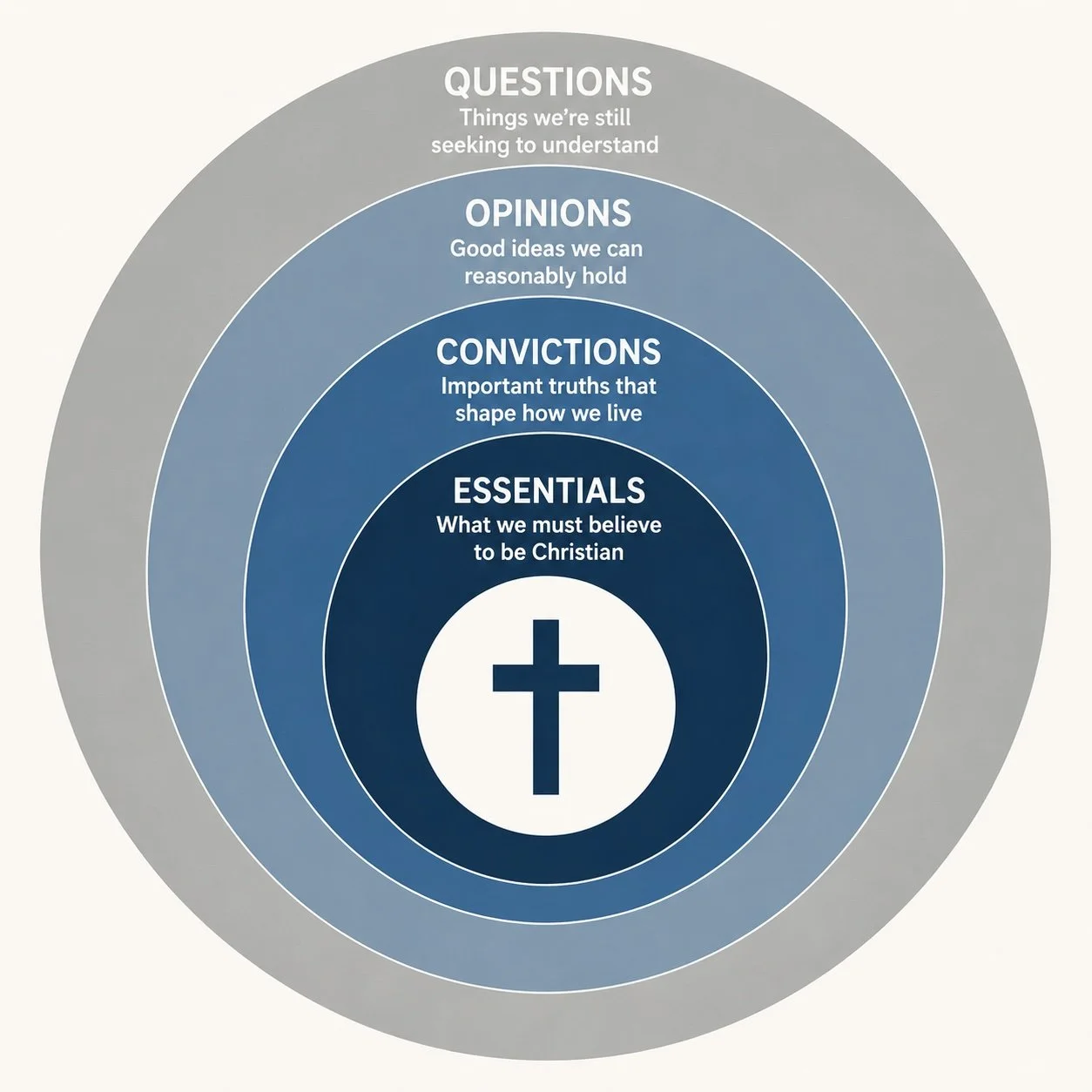
One of the most helpful ways to understand our approach is to picture a series of circles.
At the very centre is Jesus Christ and the gospel.
Everything else flows from there.
The closer a belief is to the centre, the more important it becomes to our identity, unity, and fellowship. The further it is from the centre, the more freedom Christians can have while remaining united in Christ.
At the centre are the historic Christian convictions that have united believers across centuries, cultures, and denominations.
Around this centre sit other important convictions. Some shape our identity as Baptists. Others are matters on which faithful Christians have reached different conclusions.
While these issues matter, we do not believe they should distract us from the person of Jesus or the mission He has given His Church.
We believe the Church is most fruitful when believers unite around Jesus and His mission rather than dividing over every secondary issue.
-
Wynnum Baptist Church is part of the Baptist family of churches, and we are grateful for that inheritance. Our Baptist heritage has shaped many aspects of our church life, including believer’s baptism, congregational governance, freedom of conscience, and the authority of Scripture.
At the same time, we see ourselves as followers of Jesus before we see ourselves as Baptists.
Over the years, people from many different Christian traditions have found a home at Wynnum Baptist Church. Some have come from Baptist churches, while others have come from Pentecostal, Anglican, Catholic, Reformed, Methodist, and many other backgrounds. Many have no church background at all.
We believe this reflects the reality that God’s family is larger than any one denomination. While we are grateful for our Baptist heritage and continue to be shaped by it, we also recognise that God has worked powerfully through many different streams of the Christian Church throughout history.
Strong Convictions, Open Hands
We do not believe humility requires uncertainty.
We encourage people to study Scripture carefully, think deeply, and develop convictions of their own.
Humility is not the absence of conviction. Humility is recognising that sincere followers of Jesus may sometimes reach different conclusions and that we may still have something to learn from one another.
We believe Christian maturity is demonstrated not only by what we believe, but by how we treat those who disagree with us.
Strong convictions and genuine humility can exist together.
We are all still learning. No individual, church, denomination, or movement sees everything perfectly. For that reason, we seek to remain teachable, open to correction, and willing to continue growing in our understanding of God and His Word.
-
Because we seek to distinguish between what is central and what is secondary, diversity exists within our church. This is not simply a theological idea. It affects the way we function and live together.
At times, the church itself will reach a position on a particular issue because decisions need to be made regarding leadership, governance, ministry practice, or the overall direction of the church. That does not mean every member, leader, or pastor has necessarily reached the same conclusion. Faithful Christians can hold differing convictions while continuing to worship, serve, and pursue the mission of Jesus together.
For example, Wynnum Baptist Church affirms women serving in pastoral leadership. This position shapes the way our church is structured and led. At the same time, we recognise that faithful Christians have reached different conclusions on this issue, and some within our church hold a different personal conviction.
Similarly, we generally believe that the gifts of the Holy Spirit continue to operate today. We regularly pray for healing and seek the guidance of the Holy Spirit. Some gifts, such as prophetic impressions, words of knowledge, tongues, and interpretation, are often expressed more naturally within Connect Groups and smaller ministry settings where people know one another well and can exercise discernment together.
In practice, different groups and leaders place different levels of emphasis on these gifts. In some settings they may be actively encouraged and regularly practised, while in others they may receive very little attention. We are comfortable with this diversity provided it remains grounded in Scripture, exercised with humility, and contributes to the building up of God's people.
This approach is not always the easiest one. It would be simpler to require agreement on a much broader range of secondary issues. Choosing to hold together a church with differing convictions requires humility, patience, careful listening, and a willingness to extend grace to one another.
Yet we believe it is worth it.
We believe the Church is healthiest when people gather around a common centre rather than organising themselves around theological tribes. Our aim is to help people follow Jesus and participate in His mission, rather than persuading everyone to adopt the same position on every secondary matter.
-
A common question is whether this approach means that anything goes.
The answer is no.
While we seek to create space for diversity on secondary matters, the Bible also teaches that church leaders have a responsibility to protect the church, preserve unity, and maintain sound doctrine.
The issue is rarely that someone holds a strong conviction. Nor is it usually a problem if someone holds a minority or less common view. Healthy churches will always contain people who think differently.
The challenge arises when a person seeks to use their influence to elevate a secondary issue to primary importance, create division around a particular viewpoint, or actively promote teaching that is inconsistent with the beliefs and direction of the church.
In these situations, leadership has a responsibility to act.
Our first response is always conversation. We seek to listen carefully, understand concerns, and work toward unity wherever possible.
If an issue requires further attention, it would ordinarily be considered by the pastoral team. If necessary, it may then be referred to Church Council and ultimately to the membership of the church through the processes outlined in our constitution.
In practice, this is extremely rare. Over the past couple of decades, very few matters have progressed beyond the pastoral team. Most differences are resolved through respectful conversation, mutual understanding, and a shared commitment to keeping Jesus at the centre.
Our goal is not to police every opinion. Our goal is to protect the unity, health, and mission of the church while creating space for faithful Christians to hold different convictions on matters that sit outside the centre of our faith.
-
Before coming to Wynnum Baptist Church, I spent ten years serving as a missionary in Togo, West Africa.
During that time, I helped establish and teach in a church planting school that brought together leaders from a wide range of church backgrounds. Our first intake included Methodists, Baptists, Pentecostals, and leaders from several other traditions. The reality was that many of these men would never have naturally worked together. Some carried assumptions about one another, some were cautious of one another, and a few may never have chosen to walk into each other’s churches.
Over the two years we spent together, something changed. As they studied Scripture, prayed together, and shared life together, they began to realise that there was far more that united them than separated them. They shared a common love for Jesus, a deep respect for the authority of Scripture, and a desire to see people come to know Christ. Their differences did not disappear, but those differences gradually became less significant than the mission God had placed before them.
What happened next was not part of the course and certainly wasn’t something I organised. A group of these leaders began gathering on Saturday nights to pray for an unreached people group living in a nearby region. They met in one of the churches represented in the class and faithfully prayed that God would reveal Himself and draw people to Christ.
Over time those prayer meetings grew, and then something extraordinary happened. God poured out His presence in a way that many of us could only describe as being reminiscent of Acts 2. There was a profound awareness of God among those gathered, a deep conviction of sin, a hunger for prayer, and a fresh boldness to share the gospel. What began as a small prayer gathering quickly became something much larger.
As these leaders continued to pray and follow God’s leading, that movement spread beyond the prayer meetings and into the unreached people group they had been praying for. People began responding to the gospel, new believers gathered into churches, local leaders were raised up, and entire communities were transformed. What started with a handful of Christians from different traditions praying together became a movement that spread throughout the region.
Looking back, one of the things that struck me most was that God did not appear interested in promoting one denomination over another. He worked through people from different traditions who were united in their love for Jesus, their commitment to Scripture, and their willingness to join Him in His mission.
Those leaders continued working together long after the course had finished. They still held different convictions on a range of theological issues, but they had discovered that there was something larger than those differences. They had found a unity that was rooted in Christ rather than complete agreement on every secondary matter.
That experience shaped me deeply and continues to influence the way I think about the Church today. It taught me that theological differences matter and should not be ignored, but they are rarely the most important thing about us. When Jesus is truly at the centre, there is often far more that unites believers than separates them.
In many ways, I love that Wynnum Baptist Church reflects something of that same reality. We have people from various backgrounds, and streams of the Christian church. We do not all arrive at the same conclusions on every secondary issue, but we share a commitment to Jesus, a love for God’s Word, and a desire to see people become disciples of Christ.
That does not mean doctrine is unimportant, nor does it mean every perspective is equally correct. It simply means that we are committed to keeping the main thing the main thing. We want to be a church that holds firmly to the gospel, treats one another with grace, and remains focused on the mission Jesus has given us.
For me, that is what it means to keep Jesus at the centre.
-
Not every church approaches theology in the same way.
Some churches seek a high degree of agreement on a broad range of theological issues. We respect that and recognise the important role those churches play within the wider body of Christ.
At Wynnum Baptist Church, we have intentionally chosen to centre our unity around Jesus and the gospel while allowing diversity on many secondary matters.
For some people, a particular secondary issue becomes so important that it effectively functions as a primary issue. When that happens, it can become difficult to worship, serve, and fellowship alongside people who hold different views.
If that is your conviction, another church may be a better fit for you, and we are genuinely comfortable with that. We believe people flourish when they can participate wholeheartedly in the life of their church community.
However, if you value strong convictions held with humility, unity without uniformity, and a church that seeks to keep Jesus at the centre, we believe you may find a home here.
Love God. Love People. Make Disciples Together.